HMTD Mobile Magnetic Flux Leakage Detector Compact Drill Pipe Corrosion Crack NDT Testing System
1 General introduction
If the drill pipe is not tested before use, the damage degree cannot be grasped, and the quality cannot be guaranteed. It may cause puncture, fracture, and other accidents during the drilling process, which will bring huge economic losses to drilling production. Drill pipe non-destructive testing technology is a practical and effective method to detect drill pipe defects. It can detect and control drill pipe corrosion defects in a timely manner. Strengthen the non-destructive testing of downhole drill pipes used in oil fields in my country, which can improve the reliability of downhole drill pipe use and reduce Drilling engineering costs are an important way to improve economic efficiency and promote the development of my country’s petroleum strategy.
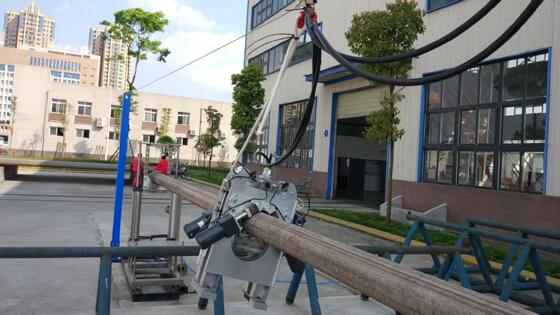
A mobile field drill pipe micro-blind area detection system is used to detect the micro-blind area of drill pipes of different specifications, to monitor the quality and safety of the drill pipe. The system consists of a probe instrument, a probe drive device, a drill pipe lifting trolley, a power supply box, a computer, and a capture card. The on-site drill pipe inspection process is as follows: After the drill pipe enters the inspection area, the walking lift cart puts the probe instrument on the drill pipe inspection rod body, lifts the drill rod, and the probe instrument automatically scans along the drill rod under the drive of the probe driving device for flaw detection The drill pipe flaw detection status is transmitted to the computer through the signal line and analyzed by the analysis and processing software to form a test report. After the flaw detection is completed, the trolley descends, the drill pipe is lowered, and the trolley moves back to allow the probe to slide away from the drill pipe. Detected area. Its characteristics are compact structure, small size, light weight, easy to move and assemble, small space for detection, can be used both inside and outside the factory, simple and standardized detection process, fast detection speed, and small detection blind area. It not only has the speed and efficiency of large-scale fixed testing equipment, but also has the mobility and flexibility of small-scale testing equipment such as ultrasound. It solves the problems of large detection blind areas of the current drill pipe detection equipment, large equipment volume, high price, difficult maintenance, difficult to move and assemble, large space when used, and the need for special workshops, large detection blind areas, and heavy labor intensity. The problem of waiting to fill the gap in the country
2.System composition
The flaw detection system is mainly composed of three parts: a mobile detection probe, a mobile console, and a computer signal processing system
|
3.1 Mobile detection host
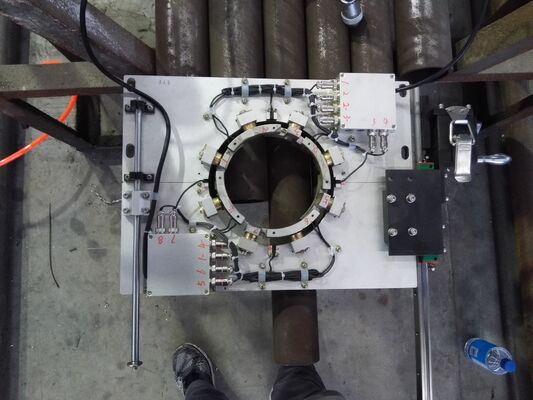
The mobile detection probe is composed of a magnetizer, a flaw detection sensor, a crawling device, and a signal preprocessor.
|
3.1.1 Magnetizer
Under the excitation of the magnetizing power source, it generates a magnetic field direction parallel to the longitudinal direction of the drill pipe. During the detection, the magnetic field magnetizes the steel pipe passing through the magnetizer, and then forms an induction magnetic field of sufficient strength in the steel pipe, which provides a basis for the feasibility of magnetic flux leakage detection.
3.1.2 Crawling device
The driving mechanism is composed of two DC reduction motors and rollers. The motor power is transmitted to the driving wheels through the coupling, which pushes the crawler to reciprocate on the drill pipe to complete the detection.
3.1.3 Flaw detection sensor
The core component of the detection sensor, it directly determines the quality of the detection signal effect, and it is the source of signal extraction. Different probe groups are selected according to the drill rods of different outer diameters, to ensure that the probe surface and the drill rod are always in good contact during the inspection, and then a good inspection effect is obtained.
3.1.4 Signal preprocessor
Its main function is to amplify and filter the detection signal output by the probe without distortion and improve the signal-to-noise ratio and anti-interference ability of the detection signal. The signal processing technology determines the overall performance of the testing equipment, as well as the technical indicators of the magnetic nondestructive testing equipment.
|
|
3.2 Mobile console and computer signal processing system
|
3.3 Mobile console
The mobile console is mainly composed of electrical control system, excitation power supply, motor drive power supply and voltage stabilizer, as shown in Figure
3.3 The electrical control system is the core unit to realize the whole detection process, through which the movement mode of the mobile detection probe, the on-off of the magnetizer and the collection of the detection signal are controlled.
|
| 3.4. The inspection process |
(1) When the tested drill rod rolls to the inspection area on its support frame, the inspector moves the inspection auxiliary trolley until the hydraulic lifting mechanism can lift and touch the two ends of the drill rod, and at the same time self-driving The probe moves with the trolley and sets it on the drill rod;
(2) The hydraulic lifting mechanism on the trolley lifts the drill rod so that the probe crawls on the drill rod over the drill rod support frame to complete the scan;
(3) The lifting mechanism lowers , The drill rod is placed on the support frame, and the inspection probe is dropped on the support platform of the trolley at the same time;
(4) The inspector removes the trolley and allows the probe to pass through the end of the drill rod and remove the drill rod;
(5) Move the tested drill rod Open, and then move into the next drill pipe to be tested.
|
3.The principle of system detection
Magnetic flux leakage detection method is currently recognized as the most reliable detection method for tubular ferromagnetic materials. Its main characteristics are fast detection speed, good detection effect, simple operation, strong anti-interference, and pollution ability, and it has been obtained in the defect detection of various magnetic conductive components It has a wide range of applications.
The system uses the principle of magnetic flux leakage detection (MFL) to detect defects (cracks, holes, wear, etc.) in drill pipes. The basic principle of Mfl method detection is based on the high permeability of ferromagnetic materials. The detection principle is shown in Figure (1) below. The permeability of the drill pipe at the defect caused by corrosion or external force is much smaller than that of the drill pipe. It is magnetized under the action of an external magnetic field. When there is no defect in the drill pipe, most of the magnetic flux (abstracted as magnetic field lines) passes through Drill pipe, at this time, the magnetic flux (abstracted as magnetic field lines) is evenly distributed. When there is a defect in the drill pipe, the magnetic flux (magnetic field lines) bends and a part of the magnetic flux (magnetic field) leaks out of the surface of the drill pipe. Magnetic sensitive components are used to detect. The distortion of these magnetic fields can obtain information about defects in magnetically conductive components such as pipe rods.



 Ihre Nachricht muss zwischen 20 und 3.000 Zeichen enthalten!
 German